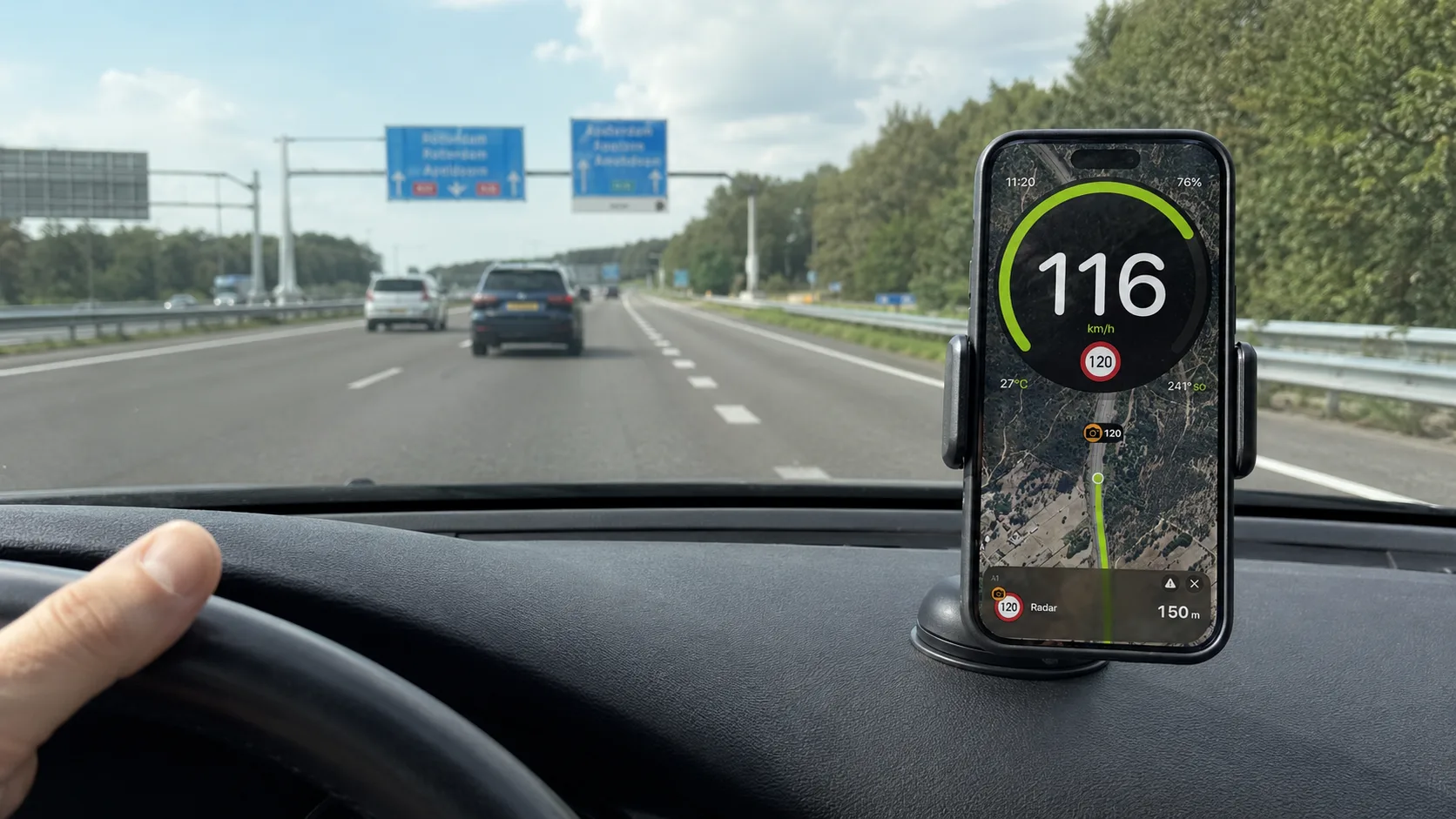
Fixed speed cameras
Permanently installed units that measure speed at a point. Some are conspicuous and others blend into their surroundings; visibility varies by installation and country.
Fixed systems can use radar, laser or road sensors; the method depends on the model. Evidence may combine a measured speed with photographs or video. Some systems use successive images as a secondary check. Visible flash, infrared illumination and daylight imaging are different options, so the absence of a visible flash does not tell you whether a measurement was made.
— Manufacturers and product families you'll see named in the press: Gatsometer (the Dutch firm that gave the British nickname "Gatso" to almost every speed camera), Vitronic Poliscan, Jenoptik / Robot, Truvelo D-cam, MultaRadar.
Mobile and handheld cameras
The same speed-measurement physics, but operated by the police rather than installed on the road.
Mobile equipment may be handheld, tripod-mounted or fitted to a vehicle, using radar or laser according to the device. Locations can change. Some database products include previously reported mobile-control sites, but a mapped site does not establish that a patrol is there now. Our app does not provide live mobile-patrol detection.
Average-speed cameras (SPECS, Tutor, Section Control)
A pair (or chain) of cameras enforces the limit across a stretch of road, not at a single point.
Cameras read a vehicle’s number plate at checkpoints and record the time. Distance divided by elapsed time gives the average speed across the section. What matters is the whole journey between the measurement points, not just the speed beside either camera.
— Names associated with section enforcement include SPECS in the UK, Tutor in Italy, radar tronçon in France and Section Control in Austria. They share the distance-over-time principle; equipment and operating rules can differ.
Germany ran a Section Control pilot on the B6 near Hannover that was suspended in 2024; the technology itself remains widely used in neighbouring countries.
Red-light cameras
Catch drivers who enter an intersection after the signal has turned red.
Triggering is by induction loop (a current pulse fires when a vehicle crosses the stop line on red) or by video analytics (the camera "sees" the light state and the vehicle position). Two photos are usually captured to establish that the vehicle moved through the intersection rather than just stopped on the line. Red-light enforcement does not normally measure speed.
Combined speed + red-light cameras
One device, two enforcement modes — used at junctions where both speed and signal compliance matter.
On a green or amber light the device functions as a fixed speed camera. On red, the same hardware photographs vehicles entering against the signal. These cabinets are common at high-risk urban intersections.
ANPR cameras
Cameras that read your number plate as you pass, in real time.
ANPR stands for Automatic Number Plate Recognition. It reads a vehicle’s registration plate and can support tolls, access controls, parking or police vehicle checks. Combined with timestamps at known points it can support average-speed enforcement. Reading a plate alone neither measures speed nor identifies the person driving.
Danger zones (France)
A road-alert zone, not a camera or a measuring device.
French rules restrict warnings about the location of enforcement equipment. A danger-zone alert marks a stretch of road for attention rather than an exact camera point. Our app uses regional zone presentation in France. A zone’s appearance or length does not by itself establish legal compliance; see the country guide for the official rules.
Less common types
You'll meet these occasionally — they're usually not what people mean by "speed camera".
Bus lane cameras (enforce dedicated-lane restrictions), weight-check cameras (commercial vehicles), height-restriction cameras (tunnels and bridges), no-overtaking cameras (specific motorway segments), and stationary police checkpoints. Most do not measure speed; some do not photograph at all and just trigger an alarm for an officer downstream.