

Speed Cameras: The Complete Guide
How speed cameras work, the main types, where they operate, and how location-based alerts differ from radar detectors.
Speed-camera approach alerts, powered by SCDB.info.

What is a speed camera?
A speed camera records evidence of a vehicle’s speed for enforcement. Radar, LiDAR (laser) and road sensors can measure speed at one point. Average-speed systems use automatic number-plate recognition (ANPR) to match a vehicle between checkpoints and calculate distance divided by travel time. ANPR alone reads a registration plate; it does not measure speed.
How speed cameras work
These measurement methods and identification technologies support different kinds of enforcement. The equipment and installation determine how each system works.
Radar
A microwave signal reflects off a moving vehicle. The device calculates speed from the change in frequency, known as the Doppler effect. Frequency bands, range and installation requirements vary by model and jurisdiction.
LiDAR (laser)
Laser pulses measure the distance to a vehicle repeatedly. The change in distance over time gives its speed. A narrow beam helps target a particular vehicle; performance depends on the device and operating conditions.
Inductive loops in the road
Sensors embedded in the road detect a vehicle passing known points. The measured time between those points can be used to calculate speed. The sensors may be unobtrusive, but the installation can also include visible cameras and flash units.
ANPR (automatic number-plate recognition)
Cameras photograph the licence plate of every passing vehicle and OCR it into text. ANPR is the foundation of average-speed enforcement: time-stamped reads at two points let the system compute how fast the same vehicle covered the distance between them.
Section / average-speed control
Cameras read a vehicle’s number plate at checkpoints and record the time. Distance divided by elapsed time gives the average speed across the section. What matters is the whole journey between the measurement points, not just the speed beside either camera.
The main types at a glance
A high-level summary — the dedicated types page goes into each one in detail.
Fixed speed cameras
Permanently installed units that measure speed at a point. Some are conspicuous and others blend into their surroundings; visibility varies by installation and country.
Average-speed cameras
A pair of ANPR cameras enforces your average speed over a stretch of road. Common on motorways and through long roadworks.
Red-light & combined cameras
Catch drivers running a red light — and, in combined units, also measure speed at the same intersection.
Where speed cameras operate
Countries use different combinations of fixed cameras, average-speed systems and mobile enforcement. Our app offers PRO camera alerts in 40+ supported countries, with SCDB.info data for parts of Europe, the USA, Brazil and Australia. Available locations and camera types vary by country and by the dataset installed in the app; this does not mean every camera is covered.
Speed camera data powered by SCDB.info — the provider maintains the camera database. Its worldwide catalogue is broader than the dataset and features available in our app.

Get warned before you reach one
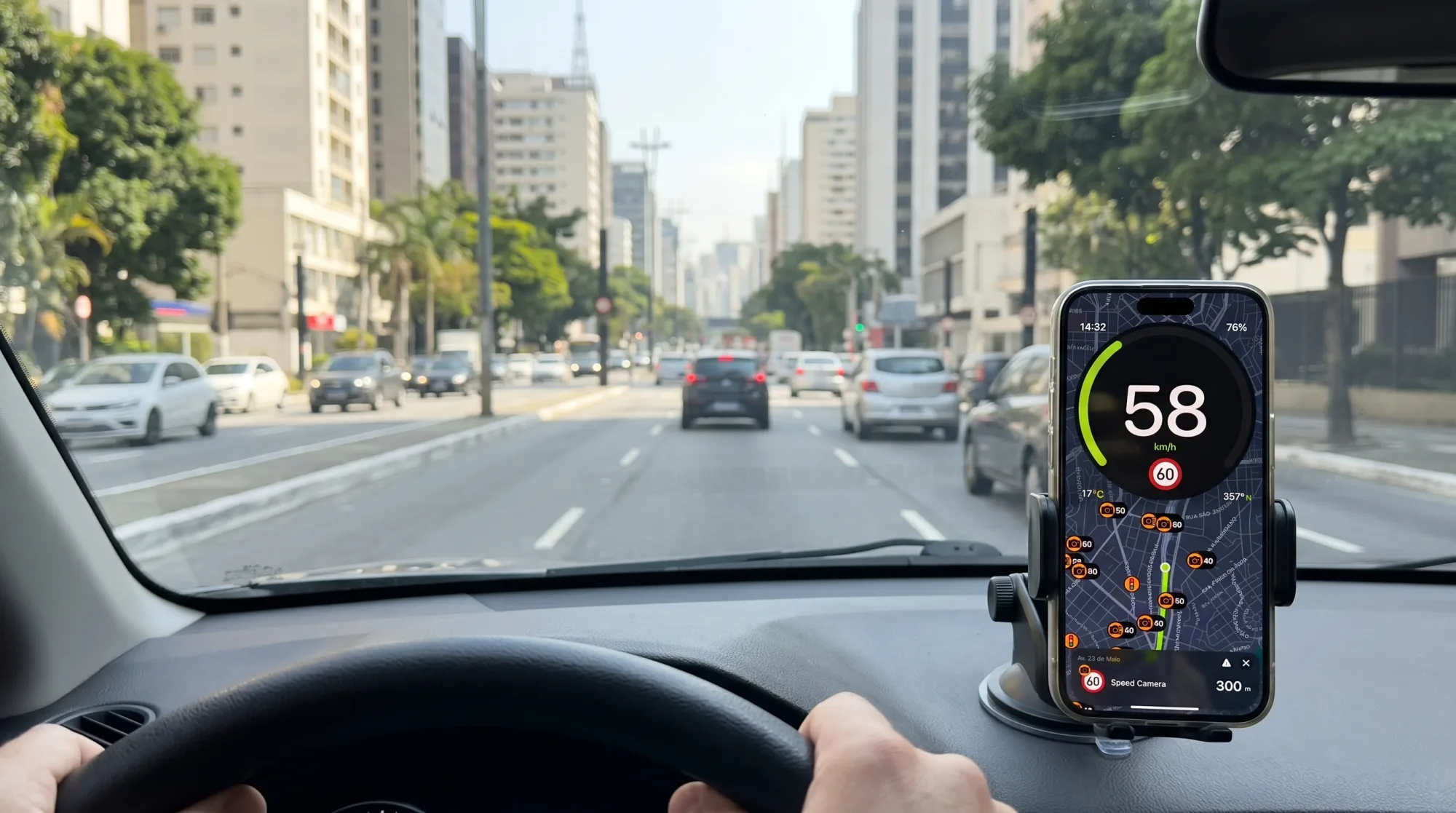
With PRO, the iPhone app compares your GPS position with stored camera locations. Alerts can be visual, audio or haptic. Approach distance uses the camera record’s speed limit when available; coverage and alert presentation vary by country.
- Camera database maintained by SCDB.info
- Audio, voice, haptic, banner, and on-map alerts
- Approach distance based on the camera’s recorded speed limit, when available
- Direction filtering helps reduce irrelevant camera alerts; it does not guarantee zero false or missed alerts. Coverage and local rules vary.
- Regional alert presentation, including danger zones in France
Are speed-camera alert apps legal?
GPS database alerts, devices that detect police signals, and jammers are different technologies and can be subject to different rules. Whether camera alerts may be used depends on the country and circumstances. Regional app settings are not a legal guarantee: check the country guide and the linked official sources before using alerts.
Speed camera FAQ
There is no single worldwide accuracy figure. Approved equipment must meet the technical requirements that apply where it is used, and measurement depends on the device and installation. A measurement-error allowance is different from an enforcement threshold; neither is permission to exceed the posted limit.
Many older cameras do, because they need a strong light to capture a clear photograph at night. Modern cameras increasingly use infrared flash that's invisible to the human eye, and some — especially average-speed systems — don't flash at all because their evidence is video-based.
Yes. Enforcement cameras can operate in tunnels, including average-speed systems that measure travel time between checkpoints. Their measurement does not depend on your phone receiving GPS; a GPS-based app can lose its position in a tunnel.
A small excess can still be enforceable. Some authorities publish guidance or apply measurement corrections, but the rules vary and a tolerance is not a higher speed limit. Do not assume that 1 mph or 1 km/h over is exempt; stay at or below the posted limit.
A speed camera is an enforcement device. A radar detector receives radar signals; a jammer interferes with signals. A GPS camera-alert app instead compares your position with stored locations and does not detect police radar. These distinctions matter, but they do not by themselves establish whether a device or app may legally be used in a country.
It depends on the country and use. Germany prohibits driver use of camera-warning functions, including when the driver knowingly benefits from a passenger’s app. France restricts enforcement-location warnings, and Switzerland prohibits camera-warning equipment and relevant GPS points of interest. Consult the country guide and official sources; an app’s regional mode is not permission to use it.
PRO camera alerts use a local camera database and GPS and can work without internet where data is available. Coverage varies by country; database updates need a connection. This does not provide offline road-speed-limit data.
SCDB.info maintains the source database and accepts reports for verification. That maintenance is separate from delivery to the app: the data stored on your phone may be older than the provider’s catalogue. Getting newer data requires an internet connection; we do not promise a fixed update interval here.
Related guides
Types of speed cameras explained
Fixed, mobile, average-speed and red-light cameras, number-plate recognition and France’s danger zones — what each does, and how a road alert differs from a measuring device.
Speed camera alerts for iPhone
How our app works, how it compares to the alternatives, and what to expect on the road.
Are speed camera apps legal? Country guide
A country-by-country reference for the legality of speed-camera alert apps and radar detectors.
Automatic speed-limit alerts
Get warned the moment you cross the posted limit — separate from camera alerts, with custom thresholds.
HUD speedometer guide
Project your speed onto the windshield. Pairs naturally with camera alerts on long drives.
Car speedometer app
GPS speed does not use wheel rotation or a tire-size setting. It still depends on usable location data.
Speed-camera approach alerts, powered by SCDB.info.
PRO alerts in 40+ countries. Coverage varies. No ads.
Always drive within the posted limit. Camera alerts are an aid to attention, not a licence to speed.