
Tire Size and Speedometer Readings: Estimate the Change
Estimate how a tire-diameter change affects a speedometer, understand the calculation limits, and compare readings without assuming GPS is ground truth.
Table of Contents
Corrected 9 September 2026: the calculations below are conditional estimates. Earlier claims of exact real speed, universal legal tolerances and guaranteed GPS precision have been removed.
Introduction
Changing tire size can alter a wheel-based speedometer’s reading. A calculator helps estimate the contribution of diameter, but it cannot measure your vehicle’s true speed or determine whether its instruments need repair.
Key Takeaways
- A larger rolling circumference covers more distance per revolution and needs fewer revolutions for the same road distance.
- If the original calibration is unchanged, a larger diameter shifts the indicated/actual relationship. Existing bias can still leave the display above actual speed.
- Tire pressure, load, wear, real rolling circumference and vehicle calibration matter.
- GPS is independent of wheel rotation, but its result also has uncertainty.
Why Tire Size Can Change the Reading
A wheel-based system converts rotation rate into speed using a calibration. At the same rotation rate a larger circumference covers more ground; at the same ground speed it rotates less often. It is incorrect to say that rotations per mile stay unchanged after circumference changes.
The calculation assumes the old tire diameter represented the original calibration. It does not prove every speedometer uses the same sensor or that the original indication had no bias.
The Math: A Conditional Diameter Model
This simplified model uses nominal geometric diameters. It assumes unchanged calibration, matching original tires, and no other source of error. Actual rolling circumference can differ. Converting an indicated speed into this estimate also assumes the original display was accurate with the original tires. The calculator does not verify that baseline.
For example, the nominal diameter of 255/70R17 is 17 × 25.4 + 2 × 255 × 0.70 = 788.8 mm. A nominal 33-inch tire is 838.2 mm. Their ratio is about 1.0626. Under the model, an indicated 60 corresponds to an estimated 63.8 in the same speed units. This is a calculation, not a road measurement.
estimated_speed = indicated_speed × new_diameter / old_diameter
diameter_change_percent = (new_diameter / old_diameter − 1) × 100
Try It With Your Tires
Enter the old and new tire sizes to explore the idealized ratio. Read the output as an estimate conditional on the assumptions above. The tool does not inspect tires, verify sensor calibration or certify a vehicle.
Illustrative Changes, Not Vehicle Tests
These examples use nominal ratios with an indicated speed of 60 in any one unit. They are not measured results for a named vehicle or tire model.
| Nominal diameter ratio | Estimated speed at 60 indicated |
|---|---|
| 0.98 | 58.8 |
| 1.00 | 60.0 |
| 1.05 | 63.0 |
Comparing Readings With Your iPhone
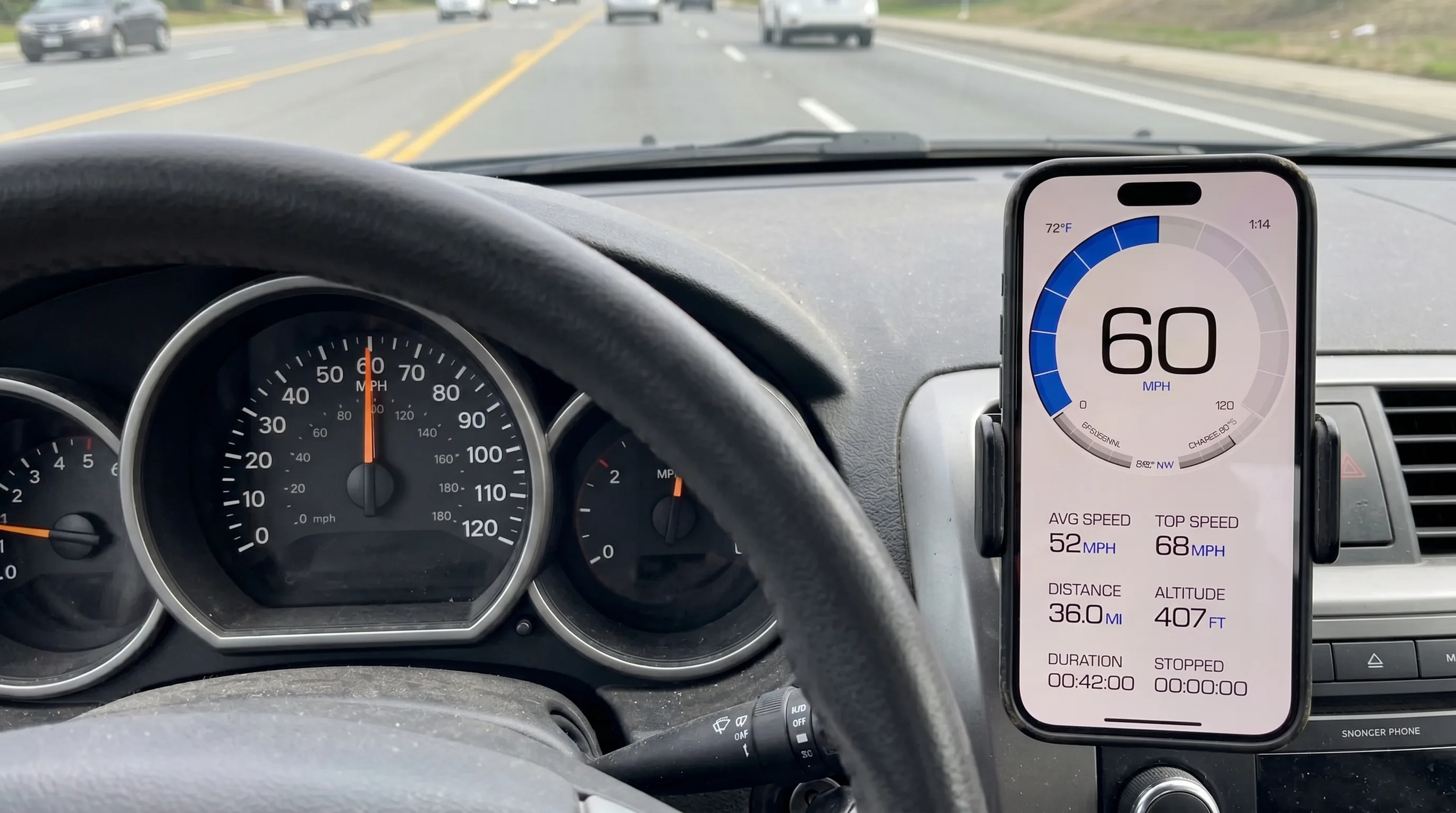
Set up the phone while stopped, or let a passenger observe it. With a usable location signal, compare the GPS estimate and dashboard at steady speed in suitable conditions. A difference can come from either measurement; it does not identify which instrument is wrong.
GPS provides an estimate of speed over ground, independent of wheel size. Signal quality, obstructions, low speed and processing can affect the reading. A fixed percentage error or greater accuracy than another instrument is not guaranteed.
Recording, saving and basic viewing of trips are free. Detailed route playback and analysis require PRO.
Free to download, with no ads. PRO is available through a subscription or a one-time purchase; both unlock the same PRO features. The price depends on your region and current offer; check Apple’s purchase screen.
GPS and Timed-Distance Checks Have Different Limits
A timed-distance check estimates average speed as distance divided by elapsed time. Distance uncertainty, timing and changing speed affect the result. A GPS display estimates speed from location-service data, subject to its own limitations. Neither method is assigned a fixed error bound here, and neither alone is an instrument calibration. A driver should not operate a stopwatch or phone while moving.
What the Calculation Cannot Say About Compliance
An arithmetic result cannot establish roadworthiness, legal compliance or an enforcement tolerance. Requirements depend on the vehicle and applicable rules. Do not infer that a small percentage change is automatically acceptable, or that a phone display replaces required vehicle equipment.
Inspection and Calibration
For an unexpected reading after a tire change, check the manufacturer’s approved sizes and calibration procedure with a qualified workshop or inspection service. Options depend on the vehicle. A GPS app can provide an additional estimate while investigating; it is not a substitute for an inspection, repair or required calibration.
Common Mistakes
Keeping nominal diameter similar does not verify fitment, load capacity or calibration. A percentage increase relative to indicated speed is not the same percentage under-reading relative to actual speed. For example, 60 → 63 is a 5% increase over 60, but 60 is about 4.76% below 63.
Frequently Asked Questions
Does the odometer change too?
If it shares the wheel-rotation calibration, the same ratio can estimate a distance change. At a ratio of 1.05, 100 indicated distance units correspond to an estimated 105 travelled. Actual calibration and rolling circumference may differ. Apply the ratio only to the indicated distance driven with the affected tires, not automatically to the lifetime odometer total.
Can I use the model for motorcycles, trucks or RVs?
The geometric relationship is the same, but sensor arrangements, calibration and approved tire choices differ. The result does not establish suitability for a particular vehicle.
Why do GPS and the dashboard disagree with original tires?
Possible causes include instrument calibration, tire conditions, signal quality and processing. A comparison alone cannot isolate the cause.
Sources and Further Reading
GPS.gov: GPS Accuracy explains that receiver design, signal blockage and other conditions affect speed accuracy. Signal-in-space performance is not a measured guarantee for this app.
Using the Result
Use the calculator to understand the diameter contribution and decide what to investigate. Keep the estimate separate from a measured vehicle calibration.
Core GPS speed tracking and trip recording work without internet, with location permission and a usable GPS signal. Automatic road-speed-limit data and weather need internet. Maps and other connected features may be unavailable offline.