
Tire Size and Your Speedometer: How to Find Your Real Speed
New tires can shift your speedometer reading by 6 mph at highway speed. Here's how the error works, how big it is, and how to find your true speed in 60 seconds.
Table of Contents
Introduction
You bought 33s for your Wrangler. Or you put plus-size 19-inch wheels on your sedan. Or your tire shop installed a size that wasn’t quite the OEM spec because “it’s basically the same.” Now your dashboard speedometer says 65 mph105 km/h and you’re not entirely sure that’s true anymore — and you’re right to be suspicious.
Your car’s speedometer doesn’t actually measure your speed. It measures how fast your tires are spinning, then converts that to a number using one fixed assumption: that your tires are exactly the diameter they were when the car left the factory. Change the tires and that assumption breaks. The bigger the change, the bigger the lie. In this guide you’ll see exactly how the error works, the actual numbers for common tire upgrades, a free calculator that gives you your true speed in 60 seconds, and the three ways to verify your real ground speed with your iPhone.
Key Takeaways
- Larger tires make your speedometer read slow — you’re actually going faster than the dashboard says.
- A 3% diameter increase = ~2 mph3 km/h error at 60 mph97 km/h. A 10% increase = ~6 mph10 km/h error.
- Bigger tires also undercount your odometer — what reads as 100,000 miles may actually be 105,000+.
- GPS speed is unaffected by tire size because it measures your motion across the ground, not wheel rotation.
- US and EU law require speedometers to read at or above actual speed — so over-reading is legal, under-reading isn’t.
- Free calculator below computes your real speed from your old and new tire sizes, in MPH or KM/H.
- No calculation needed if you use a GPS speedometer app — it shows your true speed regardless of what’s under your car.
Why New Tires Break Your Speedometer
The hidden assumption inside every speedometer
Your speedometer measures one thing: how many times per second your wheels rotate. A sensor on the wheel hub or transmission counts rotations and feeds that number to the dashboard. The dashboard then multiplies by an internally programmed constant — your tires’ circumference at the time of manufacture — to display a speed.
When that constant matches reality, your speedometer is accurate (give or take the 3–7% over-reading built in for legal safety margin). When you change tires, the constant no longer matches reality. The wheels still rotate the same number of times per mile, but each rotation now covers a different distance.
Picture two cyclists pedaling at the same cadence. The one on bigger wheels travels further per revolution. From the cadence sensor’s perspective, they look identical — same rotations per second. But on the ground, one is moving faster.
Bigger tires = speedometer reads slow
Larger-diameter tires cover more ground per rotation than the originals. Your wheels are turning at the same RPM, but you’re covering more distance, so your true speed is higher than what the speedometer shows.
A common scenario: you upgrade from stock 255/70R17 tires to 33×12.50R17 off-road tires for a Jeep, Tacoma, or Bronco. The stock diameter is roughly 31.1 inches. The new diameter is 33 inches. That’s a 6.1% increase. At an indicated 60 mph97 km/h, you’re actually doing about 63.7 mph103 km/h.
Smaller tires = speedometer reads fast
The reverse also happens. Worn-down tires, smaller “winter” tires for the same wheel size, or a swap to a lower-profile aftermarket spec all reduce diameter. Smaller diameter means less ground covered per rotation. Your speedometer over-reads even more than the factory bias already includes.
Tire wear is the sneaky one. A new performance tire might be 25.5 inches in diameter. After 40,000 miles of wear, that same tire may have lost 5–6 mm of tread — knocking the diameter down by about 0.4 inches, or roughly 1.5%. Not enough to feel, but enough that your indicated 65 mph105 km/h is actually closer to 64 mph103 km/h at the end of the tire’s life.
The Math: How Speedometer Error Works
The formula is simple, and it’s worth understanding before you trust any calculator (including ours):
actual_speed = indicated_speed × (new_tire_diameter / old_tire_diameter)

error_percent = ((new_diameter − old_diameter) / old_diameter) × 100
That’s it. There’s no other variable. Your speedometer doesn’t care about tire width, brand, tread pattern, or load rating — only diameter.
A worked example
You drive a Jeep Wrangler JL. Factory tires are 255/75R17:
- Diameter = (17 × 25.4) + 2 × (255 × 0.75) = 431.8 + 382.5 = 814.3 mm (32.1 in)
You install 33×12.50R17 off-road tires:
- Diameter = 33.0 in (838.2 mm) — the first number in high-flotation tire sizes is the diameter directly
The ratio: 838.2 / 814.3 = 1.0294. That’s a 2.94% increase.
At an indicated 70 mph113 km/h, your real speed is 70 × 1.0294 = 72.1 mph116 km/h.
At an indicated 80 mph129 km/h, your real speed is 82.4 mph133 km/h. So if your dashboard says 80129 in a 75-mph120-km/h zone, you’re already 7.4 mph12 km/h over.
The error grows with speed
This is the part that catches people off guard. A 3% error is 1.5 mph2.4 km/h at 50 mph80 km/h indicated, but 2.25 mph3.6 km/h at 75 mph120 km/h indicated. The percentage stays the same; the absolute difference grows with speed. That’s why bigger tires bite hardest on the highway.
Try It With Your Tires
Punch in your factory and current tire sizes below. The calculator returns your real ground speed at any indicated speed, the error percentage, and how much your odometer has drifted. Supports metric (225/65R17), high-flotation (33×12.50R17), LT and ST sizes, and direct-diameter input — in MPH, KM/H, or knots.
How Much Error Common Tire Upgrades Cause
Some real-world numbers. Each row assumes your speedometer reads exactly 60 mph97 km/h; the “actual speed” column shows your true ground speed.
| Vehicle category | Factory tire | Upgraded to | Diameter change | Actual at 60 mph97 km/h indicated |
|---|---|---|---|---|
| Sedan plus-sizing | 225/55R17 | 245/45R18 | +0.4% | 60.2 mph97 km/h |
| Compact SUV winter set | 235/65R17 | 215/65R17 | −2.5% | 58.5 mph94 km/h |
| Pickup leveling kit | 265/70R17 | 275/70R17 | +1.4% | 60.9 mph98 km/h |
| Wrangler mild upgrade | 255/75R17 | 285/70R17 | +1.8% | 61.1 mph98 km/h |
| Wrangler 33” off-road | 255/75R17 | 33×12.50R17 | +2.9% | 61.8 mph99 km/h |
| Wrangler 35” off-road | 255/75R17 | 35×12.50R17 | +9.0% | 65.4 mph105 km/h |
| Wrangler 37” off-road | 255/75R17 | 37×12.50R17 | +15.2% | 69.1 mph111 km/h |
| Tacoma 33” upgrade | 265/70R16 | 33×12.50R16 | +7.7% | 64.6 mph104 km/h |
| F-150 35” upgrade | 275/65R18 | 35×12.50R18 | +6.7% | 64.0 mph103 km/h |
| RV / class C | 245/70R19.5 | 265/70R19.5 | +3.1% | 61.9 mph100 km/h |
The takeaway: anything past about a 5% diameter increase puts you in real “could get pulled over” territory. The 35-inch and 37-inch jumps on a Wrangler are large enough that a stock cluster is essentially decorative until you recalibrate or run a GPS speedometer alongside.
How to Verify Your Real Speed With Your iPhone
Three methods, in order of practicality:
Method 1: Run a GPS speedometer app while driving
This is the lowest-effort, highest-accuracy option. A GPS app reads your position from satellites several times per second and computes speed from how far you’ve moved between samples. It doesn’t care what’s under your car — bald tires, brand-new 37s, or no tires at all (please don’t try this), GPS gives you your actual ground speed.
Open the app. Mount the phone on the dash or in a vent clip. Compare the GPS reading to your speedometer at a steady highway cruise. The difference is your speedometer error. Done.
Why this works for any tire size: GPS measures position over time, not wheel rotation. The math is unrelated to your tires.
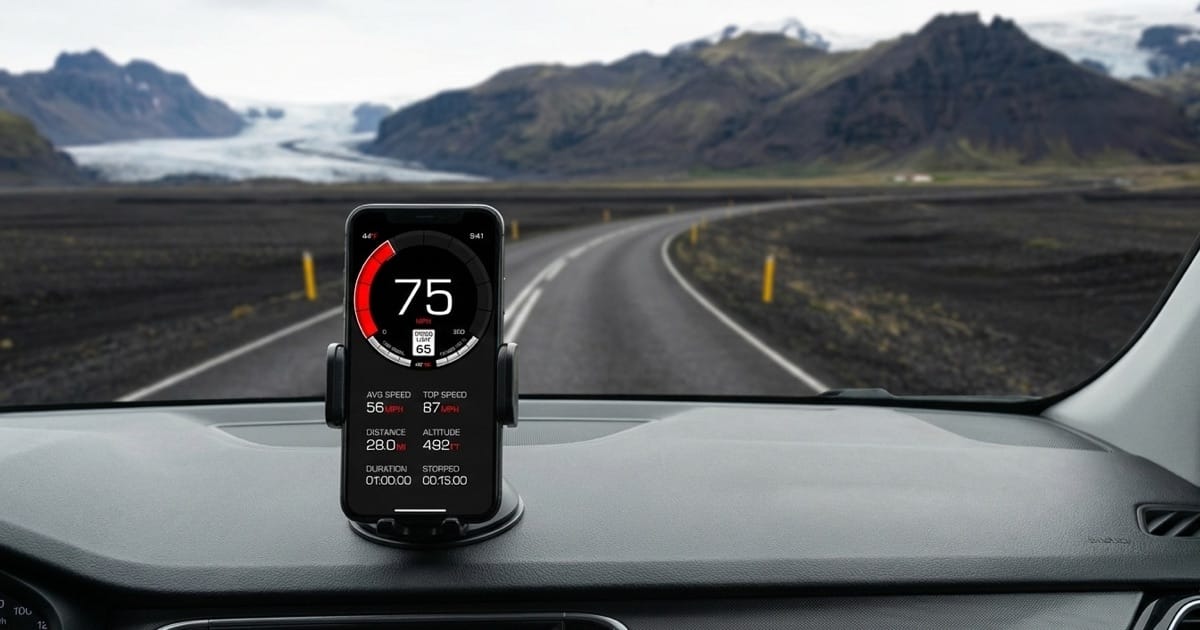
GPS Speedometer for iPhone does this with no subscription, works offline, and supports MPH, KM/H, and knots. The HUD mode mirrors the speed onto your windshield at night so you can keep your eyes up.
Method 2: The mile-marker test
The old-school method. On a flat, straight highway with mile markers (most US interstates qualify), set your cruise control at an indicated speed — say, 60 mph. Time how long it takes to travel exactly one mile between markers.
- 60 seconds → you’re going exactly 60 mph
- 58 seconds → you’re going 62.1 mph (your speedometer reads slow by 3.5%)
- 62 seconds → you’re going 58.1 mph (your speedometer reads fast by 3.2%)
The formula: actual_speed = 3600 / seconds_for_one_mile.
Limitations: elevation changes, wind, and starting/stopping your stopwatch at the exact moment you pass each marker all introduce error. You also have to take your eyes off the road to read a stopwatch, which is the opposite of what you want at 60+ mph100+ km/h. Treat this as a sanity check, not a precise measurement.
Method 3: The tire-size calculator
If you know your factory tire size and your current tire size, the tire size speedometer calculator above gives you the exact theoretical error in 60 seconds — no driving required. Use it before you buy new tires to predict the impact.
The catch: it only accounts for the diameter change. It doesn’t catch other sources of error like worn factory speedometer sensors, transmission swaps, or differential gear changes. For those, you need Method 1.
Why GPS Beats the Mile-Marker Method
The mile-marker test has been the standard tire-size verification method for decades. It still works. But a phone GPS beats it on every axis except availability of mile markers:
| Method | Accuracy | Hands-free | Speed of result | Available anywhere |
|---|---|---|---|---|
| Mile markers | ±2 mph±3 km/h (operator dependent) | No (stopwatch) | 60+ seconds | Only on marked highways |
| Phone GPS | ±0.2 mph±0.3 km/h | Yes (just glance) | Instant | Yes |
| Police radar | ±1 mph±1.6 km/h | N/A | Instant | Only when they’re aimed at you |
The decisive factor for most drivers isn’t precision — both methods are accurate enough to confirm a 3–6% speedometer error. It’s that GPS keeps both your hands on the wheel and your eyes on the road. Pull over once after the install to verify, then trust the readings.
When Speedometer Error Is Legal — and When It Isn’t
This part surprises people. Speedometer over-reading isn’t a defect; it’s a legal requirement. Under-reading is what gets manufacturers in trouble.
The US: SAE J1226 and FMVSS
In the United States, FMVSS doesn’t set a specific accuracy tolerance, but the relevant industry standard is SAE J1226. It permits ±4% error, but in practice manufacturers calibrate to over-read by 2–7% as a safety margin. The federal posture is consistent: better to have drivers think they’re going faster than they really are than the reverse.
The EU and UK: ECE Regulation R39
Europe is stricter and explicitly one-sided. UNECE Regulation 39 says a speedometer must not under-read at any speed. It may over-read by up to:
10% of actual speed + 4 km/h (about 2.5 mph)So at an actual 62 mph100 km/h, your dashboard can legally show anywhere from 62 to 71 mph100 to 114 km/h. It cannot legally show 61 mph99 km/h. This is a hard regulatory floor.
What this means for you after installing bigger tires
If your bigger tires make the speedometer under-read (the typical case), you’ve moved your vehicle into a configuration that doesn’t meet ECE R39, even though the speedometer hardware itself is unchanged. Your vehicle as configured is now non-compliant in the EU/UK. In a US insurance dispute after an accident, an under-reading speedometer is a contributing factor a lawyer can point at.
For smaller-than-stock tires (over-reading), you’re still legal under both regimes — you might be driving slower than you think, but you’re not breaking the rule.
This is the technical reason why diesel-truck owners with 37s and lift kits often pay for an ECU reprogram or a SpeedoBox-type correction module. It’s not just about accuracy; it’s about staying inside the legal envelope.
Should You Recalibrate or Just Use GPS?
Two paths to fix the issue. Pick based on how much you drive and how big the error is.
Recalibrate the speedometer
Cost: usually $80–250 for a handheld programmer (Hypertech, Bully Dog, SCT) or an inline correction module. Some vehicles need a dealer flash, which can run $150–300.
When recalibration is worth it:
- Daily driver where the speedometer is your primary speed reference
- Vehicle with a digital cluster that supports OEM recalibration via diagnostic port
- Towing/RV setups where the displayed speed needs to match your CB radio and trucker rules
- Cars that drift across multiple states with strict trooper enforcement
When it’s not worth it:
- Weekend-only or off-road-mostly vehicle
- You also want speed-limit alerts and trip recording (GPS does both)
- The error is small (<3%) — the factory over-reading absorbs it
- Your truck has 37s and a 6” lift; the speedometer is the least of your cluster’s problems
Use a GPS speedometer alongside the dashboard
Cost: free (it’s just an app on your phone you already have).
Why this works for most drivers:
- The displayed speed is your actual speed, regardless of tire size
- Works in any vehicle you climb into — useful if you drive a rental or a friend’s truck
- Adds speed-limit alerts, trip recording, and HUD projection that no factory cluster provides
- No risk of breaking the OEM cluster software
For most people who put aftermarket tires on a daily driver, running GPS Speedometer for iPhone as a second screen on a vent mount is the right answer. Cheaper, more flexible, more features.
Common Mistakes and Myths
Myth 1: “My speedometer is always wrong by the same amount.”
False — tire wear is continuous. A speedometer calibrated for new tires (25.5 in diameter) gradually drifts as tread wears down. A tire with 60% wear may be 0.7 inches smaller in diameter than when new. The error you measured 20,000 miles ago is not the error you have today.
Myth 2: “Plus-sizing keeps the speedometer accurate as long as I keep the diameter the same.”
True in principle, false in practice. The “stay within 3% of stock diameter” rule from tire shops is intended to keep error small, but most plus-sizing introduces 1–3% error in some direction. It’s small, but not zero.
Myth 3: “Bigger tires mean my odometer reads high, so I’m paying for more miles than I drove.”
Backward. Bigger tires under-count rotations per mile, so your odometer reads low. You’re driving 105 miles for every 100 the odometer logs. Your car has more wear on it than the gauge shows — relevant when you sell.
Myth 4: “GPS gets confused by tires too.”
No. GPS measures your position via satellites and computes speed from how far you’ve moved. It has no connection to anything inside your vehicle. The only way to fool a GPS speedometer is to physically move the satellites, which is beyond the budget of most aftermarket shops.
Frequently Asked Questions
How accurate is this tire-size speedometer calculator?
The calculator is exact in the math — it returns the precise ratio between your old and new tire diameters. The only uncertainty is in how the manufacturer originally calibrated your factory speedometer (most over-read by 2–7%) and in how worn your tires currently are. For new tires of known size, expect the calculator to be within 1% of real-world results.
Do bigger tires make my speedometer read slower or faster?
Bigger tires make the speedometer read slower than actual speed. You’re going faster than the dashboard shows. The bigger the diameter increase, the bigger the under-reading. A 33-inch tire replacing a 31-inch stock tire creates about a 6% under-read — your indicated 60 mph97 km/h is actually 63.6 mph102 km/h.
What’s the legal tolerance for speedometer error?
In the EU and UK, ECE Regulation R39 prohibits under-reading entirely and allows over-reading up to 10% of actual speed plus 4 km/h. In the US, SAE J1226 permits ±4%, but manufacturers voluntarily build in 2–7% over-reading as a safety buffer. Bigger aftermarket tires can push your vehicle out of compliance with the EU rule even if the speedometer hardware itself is unchanged.
Will new tires affect my odometer too?
Yes, by exactly the same percentage. If your speedometer under-reads by 5%, your odometer also under-counts by 5%. Over 100,000 indicated miles you’ve actually driven 105,000. This affects resale value (the vehicle has more wear than the gauge suggests), warranty mileage limits (you may hit them sooner than the cluster says), and oil-change intervals (you’re due earlier).
How do I recalibrate my speedometer after installing new tires?
Options vary by vehicle. Newer trucks (2015+ F-150, Ram, GM full-size) often support recalibration via a handheld programmer like Hypertech or Bully Dog ($150–300). Many Toyota and Jeep platforms need a dealer flash. Older vehicles with mechanical speedometers may need a physical gear swap in the transmission output. The broken-speedometer replacement guide covers the most common paths.
Can I use this calculator for motorcycles, trucks, or RVs?
Yes. The math is identical for any vehicle — only diameter ratio matters. Enter your factory tire size and current tire size in either metric (180/55ZR17 for a sportbike) or direct-diameter format. For an RV with low-profile commercial tires, the LT and high-flotation formats are supported. The same applies to motorcycle GPS speedometer apps.
How do I verify my actual speed without a calculator?
Run a GPS speedometer app while driving. GPS measures your position via satellites and computes speed directly — it doesn’t care about your tires, your speedometer, or your odometer. Compare the GPS reading to your dashboard at a steady highway speed. The difference is your real-world speedometer error.
Why does my GPS speed differ from my car’s speedometer even with stock tires?
Because speedometers are designed to over-read by 3–7% from the factory, even with stock tires. The over-read absorbs tire wear, manufacturing tolerances, and legal safety margin. A GPS reading that’s a few mphkm/h below your dashboard is normal — your dashboard is doing what it was designed to do.
Conclusion
A tire change is the single most common reason a speedometer goes from “accurate-ish” to “actively misleading.” The good news: the math is simple, the error is predictable, and you can verify your true speed in 60 seconds without any tools more sophisticated than the phone in your pocket.
If you’ve just installed new tires — bigger, smaller, plus-sized, or a swap your tire shop called “basically the same” — run the calculator above to see exactly where your speedometer now stands. If the error is more than 3%, either recalibrate the cluster or get used to glancing at a GPS reading next to the dashboard. If it’s less, the factory over-reading bias has probably absorbed it for you.
Either way, the cluster you see is no longer the truth. The phone in your cup holder is.
Download GPS Speedometer to see your real speed regardless of what’s mounted on your wheels. Works offline, supports MPH and KM/H, no subscription required.