
How Accurate Is a GPS Speedometer at High Speeds?
At 70 mph or 120 km/h, a phone GPS speedometer is typically accurate to ±0.1–0.2 mph — often closer to your true speed than the dashboard. Here's why, and when it isn't.

Table of Contents
Introduction
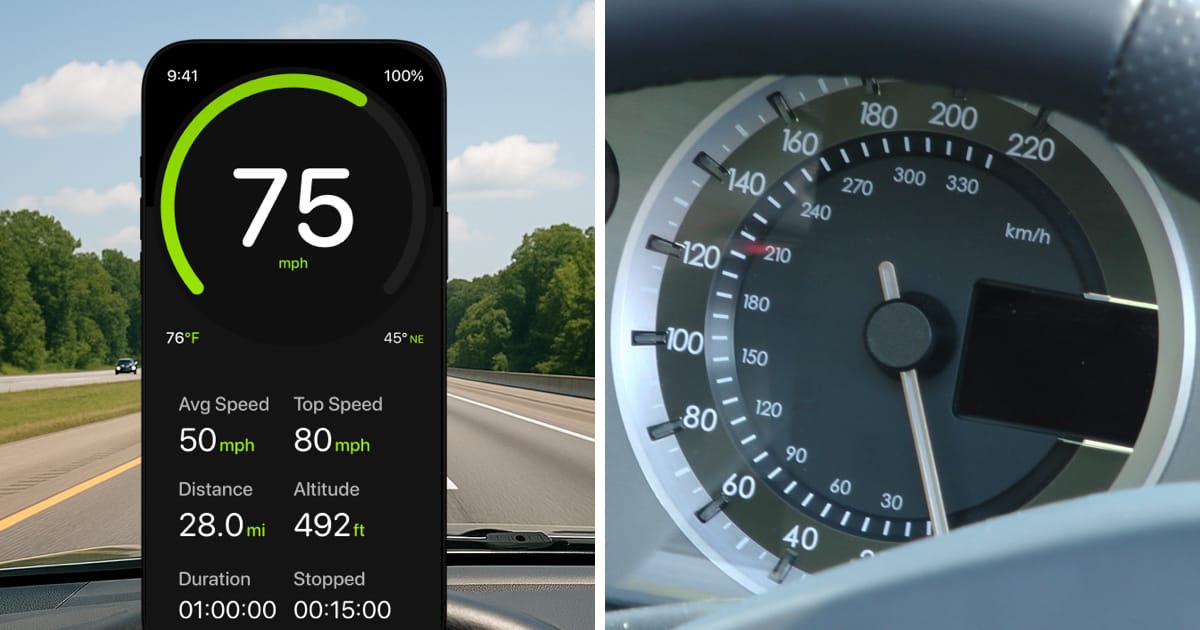
You’re cruising at an indicated 80 mph129 km/h on a clear interstate. The dashboard says 80129. Your phone says 76122. Which one is lying?
The short answer: the phone. And it isn’t lying — your speedometer is. Under normal highway conditions, a modern smartphone GPS measures speed to within roughly ±0.1 mph±0.16 km/h using Doppler shift on the satellite carrier — accuracy that beats almost every factory speedometer in the world, and gets better, not worse, at higher speeds.
That’s the part most drivers get backwards. The mental model goes: faster = harder to track = less accurate. The actual physics is closer to the opposite. GPS speed estimation is a velocity calculation, not a position-difference calculation, and the signal it relies on is cleaner the faster you’re moving in a steady direction. The things that do degrade accuracy — multipath, lock loss, low update rate, hard acceleration — have nothing to do with how high the number on the screen is.
In this guide: the real accuracy numbers at highway speeds, why Doppler is the load-bearing trick, where GPS does fall apart (tunnels, urban canyons, sharp transients), how it compares to your dashboard, and how to set your phone up so you get the most accurate reading possible at speed.
Key Takeaways
- Smartphone GPS speed accuracy at highway speeds is typically ±0.1–0.2 mph±0.16–0.3 km/h under good signal — within ~0.2% at 70 mph113 km/h.
- GPS speed comes from Doppler shift on the satellite carrier, not from dividing position changes by time. That’s why high speed doesn’t degrade it.
- Most car speedometers legally over-read by 3–10%. The dashboard saying 80 mph129 km/h usually means you’re doing 73–77 mph117–124 km/h.
- GPS doesn’t care about tire size, tire wear, or transmission gearing — three of the biggest sources of dashboard error.
- Update rate matters more than top speed. A 1 Hz GPS can lag during hard braking; a 5–10 Hz phone GPS keeps up with normal highway transients.
- The real enemies of accuracy are tunnels, urban canyons, and multipath reflections — not high speed itself.
- You don’t need internet for the speed calculation. GPS works on raw satellite signals; mobile data only helps faster initial lock.
Does High Speed Actually Hurt GPS Accuracy?
No. In most cases it improves it.
This is the counter-intuitive part. People assume that the faster you move, the harder it is for the receiver to “keep up.” But a GPS receiver doesn’t track your motion the way a camera tracks a moving object. It measures the frequency shift of the satellite carrier signal — the same Doppler effect that makes a passing ambulance siren change pitch. A faster, steadier motion produces a larger, cleaner Doppler shift than slow stop-start movement, and the receiver’s signal-processing loop locks onto it more confidently.
Two practical consequences:
- Steady highway driving is the best-case scenario for GPS speed. Smooth velocity, open sky, large coherent Doppler signal.
- The biggest GPS speed errors happen at low speed, not high speed — because the Doppler shift is small relative to noise, and any GPS receiver has to switch from velocity estimation to position-difference estimation as you approach zero.
Consumer GPS chips routinely track aircraft, motorcycles, and racing vehicles past 200 mph320 km/h without breaking a sweat. The U.S. government’s own published GPS Standard Positioning Service performance is specified for civilian receivers without an upper speed caveat. Highway driving at 70–80 mph113–129 km/h is not even close to the edge of the envelope.
How GPS Actually Measures Your Speed
There are two ways to compute speed from GPS data, and only one of them is good.
The bad way: position differences over time
The naive method is to record your position once per second, subtract, and divide by the time gap. This works — barely. Each position fix has an uncertainty of a few meters, so subtracting two fixes amplifies the noise. The result is a jittery speed number that needs heavy smoothing to be readable.
Early GPS units worked this way. Some cheap or poorly written apps still do.
The good way: Doppler shift on the carrier
Modern GPS receivers — including every smartphone GPS chip made in the last decade — measure your velocity directly from the Doppler shift of the satellite carrier frequency. As you move toward a satellite, the carrier appears slightly compressed (higher frequency); as you move away, slightly stretched. Combining the Doppler shifts from four or more satellites in different directions gives a 3D velocity vector with millimeter-per-second precision in ideal conditions.
The math doesn’t pass through position at all. That’s why:
- Speed is more accurate than position. Your phone may report “you’re somewhere in this 5-meter circle” while reporting speed to within 0.1 mph0.16 km/h.
- High speed helps. Faster motion → larger Doppler shift → better signal-to-noise.
- Tire size is irrelevant. The car doesn’t enter the calculation at all.
Want a deeper walkthrough of the underlying physics? We covered it in How GPS Speedometers Work: The Science Behind Accuracy.
Real Numbers: GPS Accuracy at Highway Speed and Beyond
Specific figures matter here, so:
| Speed | Conditions | Typical GPS speed error | Typical dashboard error |
|---|---|---|---|
| 30 mph48 km/h urban | Mixed buildings, partial sky | ±0.3 mph±0.5 km/h | +1.5–3 mph+2.4–5 km/h high |
| 60 mph97 km/h highway | Open sky, steady cruise | ±0.1 mph±0.2 km/h | +3–5 mph+5–8 km/h high |
| 70 mph113 km/h highway | Open sky, steady cruise | ±0.1 mph±0.2 km/h | +3–5 mph+5–8 km/h high |
| 100 mph161 km/h autobahn | Open sky, steady cruise | ±0.1 mph±0.2 km/h | +5–10 mph+8–16 km/h high |
| 120 mph193 km/h track straight | Open sky, dual-frequency GPS | ±0.1 mph±0.2 km/h | Varies |
| 70 mph113 km/h urban canyon | Tall buildings, multipath | ±1–3 mph±1.6–5 km/h briefly | +3–5 mph+5–8 km/h high |
| 70 mph113 km/h tunnel | No satellite signal | No reading / dead reckoning | +3–5 mph+5–8 km/h high (still works) |
The pattern: GPS error is roughly flat across speed as long as conditions stay good, while dashboard error tends to grow in absolute terms because it’s a percentage of a bigger number. At 100 mph161 km/h, a 5% dashboard over-read is 5 mph8 km/h off; the GPS is still ±0.1 mph±0.16 km/h.
This is also why GPS-based timing systems like Racelogic VBOX and Garmin Catalyst are the industry standard for vehicle testing. Automotive journalists don’t quote dashboard 0–60 times for a reason.
Why Your Car’s Speedometer Looks Worse the Faster You Go
Your dashboard is doing exactly what it was designed to do, and that design is legally required to make it read high.
In the EU and UK, UNECE Regulation 39 prohibits speedometers from ever under-reading actual speed. It may over-read by up to 10% of actual speed plus ~2.5 mph4 km/h. So at a true 62 mph100 km/h, your dashboard can legally show anywhere from 62 to 71 mph100 to 114 km/h. It cannot show 61 mph99 km/h.
US regulations (SAE J1226 industry standard) are looser but the industry posture is identical: better to make drivers think they’re going slightly faster than truth than the reverse.
This is on top of three real-world error sources:
- Tire wear: a tire that’s lost 5–6 mm of tread is ~1.5% smaller in diameter — drives the dashboard further high
- Tire size changes: going from stock 31-inch tires to aftermarket 33-inch tires flips the dashboard from over-reading to under-reading (covered in detail in Tire Size and Your Speedometer)
- Manufacturing tolerances: even two identical cars off the same line can show different readings at the same true speed
GPS sidesteps every one of these. It measures your motion across the surface of the Earth — it doesn’t know or care what’s spinning under your car. For a deeper comparison see Why GPS Speed Is More Accurate Than Your Car’s Speedometer.
Update Rate: The Hidden Spec That Affects Highway Accuracy
“Accuracy” isn’t a single number. Two GPS receivers can both report ±0.1 mph±0.16 km/h steady-state and still feel very different in the cabin, because of how often they refresh.
| Receiver type | Typical update rate | Behavior on hard braking |
|---|---|---|
| Cheap GPS logger | 1 Hz | Visible lag, reading trails truth by ~1 second |
| Standard phone GPS | 1–5 Hz | Minor lag during sharp transients |
| Modern iPhone (12+) | Up to 10 Hz | Reading tracks closely; lag rarely noticeable |
| Professional VBOX | 20–100 Hz | No perceptible lag |
For steady highway cruise, even 1 Hz is plenty. Where update rate matters is in transients: hard acceleration onto a ramp, emergency braking, or rapid drop from highway speed to a toll booth. A 1 Hz receiver will visibly trail reality during those moments while a 5–10 Hz receiver mostly keeps up.
Modern iPhones (12 and newer) use a dual-frequency L1+L5 GPS chip running at the higher end of this range, which is one reason a phone in a windshield mount often outperforms the dashboard during fast highway driving — including during the brief seconds when the cluster is showing inflated tire-based numbers.
Where GPS Speed Does Get Less Accurate
High speed isn’t the problem. These are.
Tunnels and covered structures
No sky view, no satellite signal, no fresh velocity fix. Most apps either freeze on the last known speed or attempt a brief dead reckoning estimate using the phone’s accelerometers and gyroscope. Dead reckoning works for a few seconds; in a multi-mile tunnel like the Eisenhower Tunnel in Colorado, expect the GPS reading to drift or zero out until the exit.
Urban canyons
Dense downtown areas with tall buildings on both sides create multipath: GPS signals bouncing off building faces before reaching your phone, arriving slightly late, and confusing the receiver’s range estimates. Position can wander by tens of meters; speed can briefly spike or drop by a few mphkm/h until the receiver re-locks.
Dual-frequency GPS (iPhone 12 and newer, and many recent Android flagships) cuts multipath errors meaningfully, but doesn’t eliminate them. A windshield mount with a clear sky view helps more than any setting.
Hard transients
Floor it from 30 to 90 mph48 to 145 km/h in 4 seconds, or panic-brake from 75 mph to 0121 km/h to 0, and a 1 Hz GPS will trail reality by a fraction of a second. This is the one situation where a properly-calibrated dashboard genuinely beats a low-update-rate GPS — the wheel-speed sensor responds in milliseconds. For normal highway driving with smooth speed changes, it doesn’t apply.
Poor phone placement
A phone face-down in a center console, in a deep cup holder, or behind tinted glass with metallic film loses signal. So does a phone in aggressive battery-saver mode, which can reduce GPS sampling rate to save power. We covered phone placement in detail in GPS Speed Tracking Without Internet.
Very tight curves
On twisty roads, the direction of your velocity vector is changing rapidly, even if the magnitude is constant. GPS speed handles this fine, but the position trace will look noisier — and on switchbacks, the apparent ground distance can briefly differ from your odometer in ways that confuse some apps. We dug into this in GPS Accuracy on Curves vs Straight Roads.
The “Wait, GPS Shows Less Than My Dashboard” Moment
Almost every driver who first tries a GPS speedometer has the same reaction at highway speed: “This must be wrong, my car says I’m doing 80129.”
Run through the order-of-magnitude check:
- Your dashboard reads 80 mph129 km/h
- GPS reads 76 mph122 km/h
- Difference: 4 mph7 km/h (5%)
That’s a textbook factory speedometer over-read. ECE R39 requires this direction of error in Europe. The US doesn’t require it but every manufacturer builds it in anyway. The GPS isn’t broken. Your speedometer was never trying to tell you the truth in the first place.
If you want to confirm: run the mile-marker test below, or compare against a separate device. In every case we’ve heard back about, the GPS wins.
The Mile-Marker Cross-Check
If you want to verify GPS accuracy yourself without trusting a single device:
- Find a stretch of road with distance markers (most US interstates have mile markers; many EU motorways have kilometer markers).
- Set cruise control to a steady indicated speed — say, 60 mph100 km/h.
- Start a stopwatch as you pass a marker.
- Stop it as you pass the next one.
- Compute: actual speed = 3600 ÷ seconds for one mile (in mph), or 3600 ÷ seconds for one km (in km/h).
For the imperial version: 60 seconds between mile markers = exactly 60 mph. 58 seconds = 62.1 mph (you’re going faster than you thought). 62 seconds = 58.1 mph. For the metric version: 60 seconds between km markers = 60 km/h; 36 seconds = 100 km/h; 30 seconds = 120 km/h.
In practice, the marker method is accurate to about ±2 mph±3 km/h because of stopwatch reaction time and elevation/wind variance. That’s still tight enough to confirm a dashboard over-read or to verify the GPS reading within reason. In every reasonable test, the GPS will match the marker number more closely than the dashboard does.
How to Get the Most Accurate Highway GPS Reading
A few practical changes that move the needle:
Mount the phone where it can see the sky
Windshield mount, dashboard mount, or vent clip near the windshield are all good. A phone face-up on a tray with a clear roof view is fine. A phone in a cup holder, on a charging pad behind the gear lever, or buried in a console box will lose 30–50% of the satellites it could otherwise track.
Disable aggressive battery saving while driving
iOS Low Power Mode and equivalent Android modes can throttle GPS sampling to save battery. Either plug the phone into the car (which automatically disables Low Power Mode on iOS) or toggle it off manually. We use this same setup for HUD reflection mode, covered in HUD Speedometer Guide.
Let the receiver settle for 10–20 seconds
A cold start with no recent GPS data can take 20–30 seconds to acquire a stable fix. Aided GPS (using mobile data for satellite orbit predictions) cuts this to a few seconds. Either way, the first ~10 seconds of speed readings after launching the app may be noisier than the subsequent steady state.
Use a phone with dual-frequency GPS if you can
iPhone 12 and newer ship with L1+L5 dual-frequency GPS. So do most 2020+ Android flagships. Dual frequency cuts multipath errors in half-or-better — which mostly helps in cities, but also makes the receiver more robust to sub-optimal sky views on the highway.
Don’t compare during transients
If you punch the throttle and immediately glance at the GPS to compare against the dashboard, you’re catching the GPS during its weakest moment. Wait until you’ve held a steady speed for a few seconds before deciding which is “right.”
So — Is It Accurate Enough?
For everything a normal driver actually does at high speed:
- Verifying you’re not actually speeding even when the dashboard says you are: yes.
- Checking fuel economy with accurate distance and speed: yes.
- Comparing your real performance numbers to a manufacturer’s claimed 0–60: yes, with caveats around the very first second.
- Heads-up display for night highway driving: yes — see HUD Speedometer Guide.
- Recording a road-trip log for later review or GPX export: yes.
- Legal evidence in a speeding dispute: sometimes — depends on jurisdiction, but increasingly accepted alongside police radar.
The cases where a GPS reading isn’t enough on its own — long tunnels, deep urban canyons, drag-strip-style transient tests — are well-defined, narrow, and rarely the situation high-speed accuracy actually matters for.
Frequently Asked Questions
How accurate is GPS speedometer at 70 mph?
Under good highway conditions, GPS speed accuracy at 70 mph113 km/h is typically within ±0.1–0.2 mph±0.16–0.3 km/h — about 0.2% error. That’s significantly better than the 3–10% over-read typical of factory dashboard speedometers. Modern iPhones with L1+L5 dual-frequency GPS are at the better end of this range.
Does GPS get less accurate the faster you drive?
No. GPS speed measurement is based on Doppler shift on the satellite carrier signal, and Doppler-based velocity estimation actually improves with higher steady speeds because the signal-to-noise ratio of the velocity component goes up. The biggest GPS speed errors happen at very low speeds and during sudden acceleration or braking, not at high steady speeds.
Is GPS accurate enough at 100 mph or 120 km/h?
Yes. Under open-sky conditions, GPS speed accuracy stays at roughly ±0.1–0.2 mph±0.16–0.3 km/h all the way up to and beyond 120 mph193 km/h. Consumer GPS chips can track motion well past 500 mph800 km/h; highway autobahn speeds are deep inside the comfortable operating range.
Why does GPS show a lower speed than my car’s speedometer?
Because your speedometer is designed to over-read. ECE Regulation 39 in the EU/UK requires speedometers to never under-read and permits over-reading by up to 10% plus 4 km/h. Manufacturers typically calibrate for 3–7% over-read to stay within legal limits while accounting for tire wear. The GPS is showing your true ground speed; the dashboard is doing what regulation tells it to.
Does GPS need internet to measure speed at high speeds?
No. GPS speed measurement uses raw satellite signals received directly by your phone’s GPS chip — no internet involved. Mobile data can speed up the initial satellite lock (Assisted GPS), but once locked, the speed reading runs entirely on satellite signals. Airplane mode with GPS still enabled works perfectly fine on a long highway drive.
Why does my GPS speed jump around even at steady highway speeds?
If it’s a low-cost app or older device using 1 Hz position-difference math, expect small jumps of ±1 mph±1.6 km/h from positioning noise. Quality modern apps use Doppler-derived velocity and update at 5–10 Hz, giving smooth readings. If you’re seeing larger jumps (±5 mph±8 km/h or more), check for multipath sources (urban buildings, dense tree cover) or poor phone placement (buried in console, blocked by metallic-tint glass).
Is GPS speed admissible in court for a speeding dispute?
It varies by jurisdiction. Some courts accept timestamped GPS speed logs as supporting evidence; others give precedence to calibrated police radar or lidar. The technology itself is well-established enough that professional motorsport timing uses GPS as the primary reference. If you intend to use GPS data to contest a ticket, retain the original log with timestamps rather than just a screenshot.
Can I use GPS speed instead of my car speedometer in the EU?
Legally, no — your vehicle must still have a working speedometer to pass inspection under EU rules. But you can use GPS speed alongside the dashboard, and many drivers do. With aftermarket tires that have pushed the dashboard out of ECE R39 compliance, a GPS reading is often the only honest speed reference in the cabin.
Conclusion
The fastest, simplest answer to “how accurate is a GPS speedometer at high speeds?” is: more accurate than the dashboard you’ve been trusting your whole driving life. Typical accuracy on a modern smartphone is around ±0.1–0.2 mph±0.16–0.3 km/h at any normal highway speed, in good conditions, with no degradation as the number on the screen gets bigger.
High speed isn’t the variable that hurts GPS — that was always a folk-physics intuition that doesn’t match how the receiver actually computes velocity. The real failure modes (tunnels, multipath, low update rate, bad phone placement) are well-defined and avoidable. The dashboard’s failure mode is built into regulation and your tire choices; it follows you home from the dealer.
If you want to see your actual ground speed at 70 mph113 km/h the next time you’re on the highway, mount your phone where it has a clear sky view, give it ten seconds to settle, and trust the number. It’s the one in the cabin that’s actually trying to tell you the truth.
Download GPS Speedometer for iPhone to see your real highway speed alongside your dashboard. Works offline at any speed, supports MPH, KM/H, and knots, includes HUD reflection mode for night drives, no subscription required.