
Speed Cameras: The Complete Guide
How speed cameras work, what types exist, where they operate, and how to be warned before you reach one — without breaking the law.
Speed-camera approach alerts, powered by SCDB.info.

What is a speed camera?
A speed camera is a roadside or vehicle-mounted device that measures the speed of passing vehicles and produces evidence — usually a photograph plus a measured speed — used to enforce the posted limit. Modern systems use radar, LiDAR (laser), inductive road loops, or video-based number-plate recognition (ANPR), and they range from a single point measurement to "average-speed" systems that time you across kilometres of road.
How speed cameras work
Most cameras measure speed in one of five ways. Each has trade-offs in accuracy, cost, range, and what type of road it suits.
Radar
A microwave beam (typically Ka-band) bounces off the vehicle; the device computes speed from the Doppler shift. The technology behind iconic systems from Gatso, MultaRadar and similar manufacturers. Effective range up to ~1 km; the most common technology worldwide.
LiDAR (laser)
A narrow infrared laser pulses against a single vehicle and times its return. Vehicle-specific accuracy and effective at long range, used heavily by police for handheld enforcement.
Inductive loops in the road
Two loops of wire embedded in the asphalt detect each vehicle as it passes; the device computes speed from the time gap between loops. Common with red-light/speed combo enforcement (e.g. Truvelo D-cam) and discreet because nothing is visible above road level.
ANPR (automatic number-plate recognition)
Cameras photograph the licence plate of every passing vehicle and OCR it into text. ANPR is the foundation of average-speed enforcement: time-stamped reads at two points let the system compute how fast the same vehicle covered the distance between them.
Section / average-speed control
A pair (or chain) of ANPR cameras enforces the limit across a stretch of road — typically several kilometres. The driver's average speed across the whole section is the enforced number, so braking just before the camera doesn't help. Sold under brand names like SPECS in the UK and Tutor in Italy.
The main types at a glance
A high-level summary — the dedicated types page goes into each one in detail.
Fixed speed cameras
Roadside units that measure your instantaneous speed at one point. Visible by design; deterrence is part of the point.
Average-speed cameras
A pair of ANPR cameras enforces your average speed over a stretch of road. Common on motorways and through long roadworks.
Red-light & combined cameras
Catch drivers running a red light — and, in combined units, also measure speed at the same intersection.
Where speed cameras operate
Speed enforcement is global. Some countries run dense networks of fixed cameras, others lean on average-speed systems or mobile patrols. The professionally curated database that powers our app currently covers more than 40 countries across Europe, the Americas, Brazil and Australia, with new locations curated by the SCDB team and added on a regular schedule.
Speed camera data powered by SCDB.info — a professionally curated database, regularly updated, used by navigation systems worldwide.

Get warned before you reach one
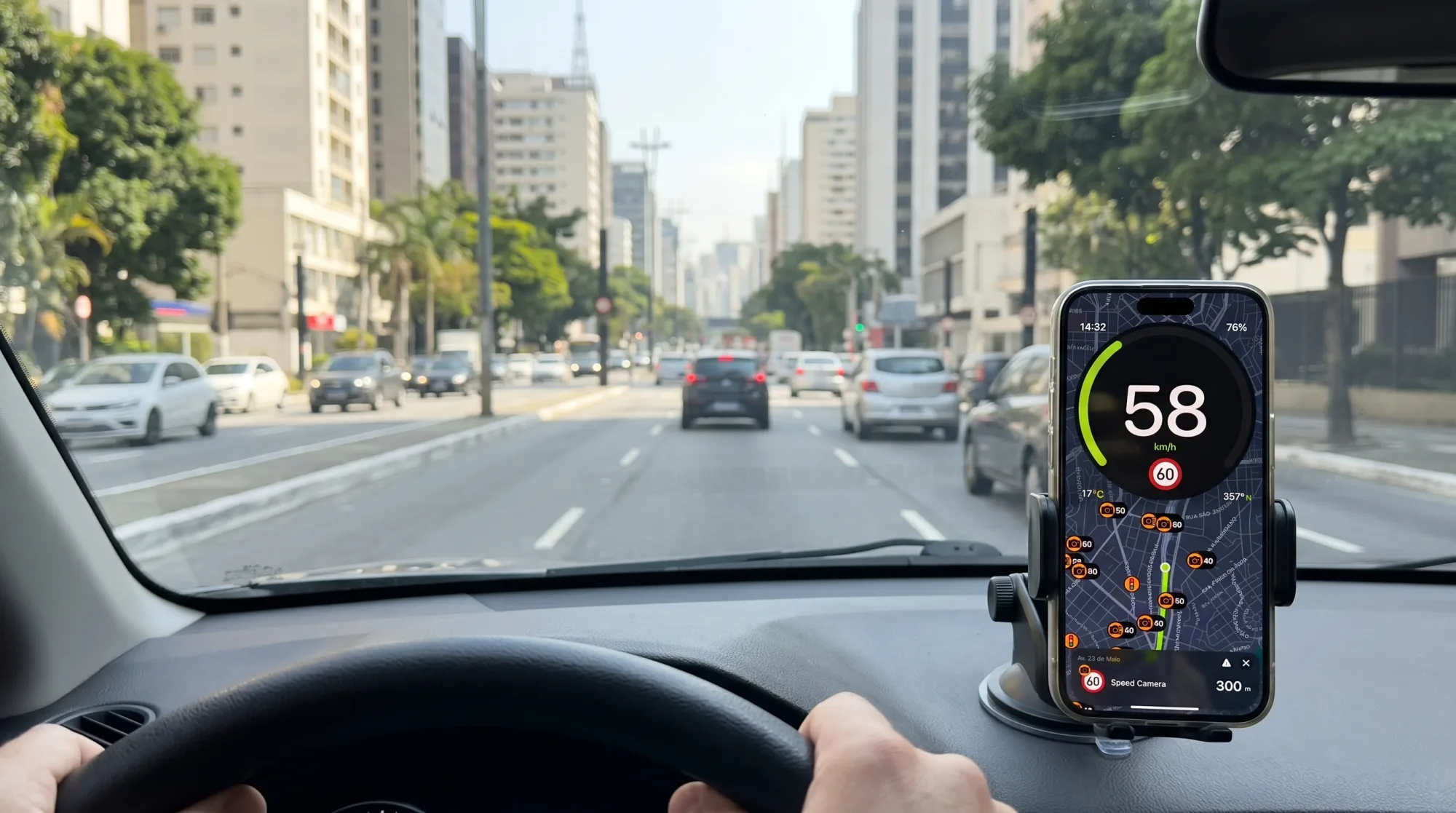
Our iPhone app reads your GPS position and warns you in time as you approach a camera. The approach distance scales with the speed limit, alerts can be visual, audio (beep, voice or radar tone), or haptic, and the feature respects local law in every country it ships in.
- Professional SCDB.info database — not crowdsourced guesses
- Audio, voice, haptic, banner, and on-map alerts
- Approach distance scales with your speed
- Direction-matched: no false alerts from the opposite carriageway
- Built-in legal-compliance per country (e.g. France danger zones, Germany driver-use restrictions)
Are speed-camera alert apps legal?
In most countries the answer is yes — apps that alert drivers to known camera locations from a public-record database are treated very differently from "radar detectors", which actively scan police signals and are banned in many jurisdictions. France, Germany, Switzerland and a handful of other countries impose specific rules on how (or whether) such alerts can be shown to the driver, and reputable apps comply automatically.
Speed camera FAQ
Type-approved cameras are extremely accurate — better than ±2 km/h at typical road speeds. Most enforcement authorities also apply a tolerance on top of the posted limit (often a few km/h or a small percentage) before issuing a fine, so the threshold for prosecution is higher than the posted number itself.
Many older cameras do, because they need a strong light to capture a clear photograph at night. Modern cameras increasingly use infrared flash that's invisible to the human eye, and some — especially average-speed systems — don't flash at all because their evidence is video-based.
Yes. Average-speed enforcement is particularly common in long road tunnels, because lighting and emergency-management considerations make excessive speed especially dangerous. The cameras are typically mounted at the entry and exit portals.
In practice, no — almost every enforcement authority operates a published or unpublished tolerance band. In the UK guidance for forces is around 10 % + 2 mph; in Germany it's 3 km/h up to 100 km/h then 3 %. Each country and region differs, so the safe approach is to stay at or below the posted limit rather than relying on the tolerance.
A speed camera is a fixed or mobile enforcement device on the road. A radar detector is a device the driver carries that scans for police radar transmissions and warns the driver in real time. Speed-camera *alert apps* are a third category — they don't scan anything; they read your GPS position and look up known camera locations in a database. That distinction matters legally: detectors are banned in many countries while POI-based alerts often are not.
In most countries, yes. France requires the app to show wider "danger zones" instead of exact camera positions, Switzerland prohibits in-vehicle camera alerts entirely, and Germany allows the data but requires it to be hidden from the driver. See our country-by-country guide for the full picture.
Yes. The camera database is bundled with the app and stored on your iPhone, so alerts work in remote areas and abroad without a data connection, wherever your iPhone has a GPS signal. Camera data is refreshed regularly.
The underlying database (SCDB.info) is maintained on a regular schedule by its curators. Updates ship to the app at regular intervals, so the camera locations you see are professionally maintained — not crowdsourced guesses.
Related guides
Types of speed cameras explained
Fixed, mobile, average-speed, red-light, ANPR, danger zones — what each one is and how they measure you.
Speed camera alerts for iPhone
How our app works, how it compares to the alternatives, and what to expect on the road.
Are speed camera apps legal? Country guide
A country-by-country reference for the legality of speed-camera alert apps and radar detectors.
Automatic speed-limit alerts
Get warned the moment you cross the posted limit — separate from camera alerts, with custom thresholds.
HUD speedometer guide
Project your speed onto the windshield. Pairs naturally with camera alerts on long drives.
Car speedometer app
GPS-grade speed readings for everyday driving — accurate to 1–2 %.
Speed-camera approach alerts, powered by SCDB.info.
40+ countries. Regularly updated. No ads.
Always drive within the posted limit. Camera alerts are an aid to attention, not a licence to speed.